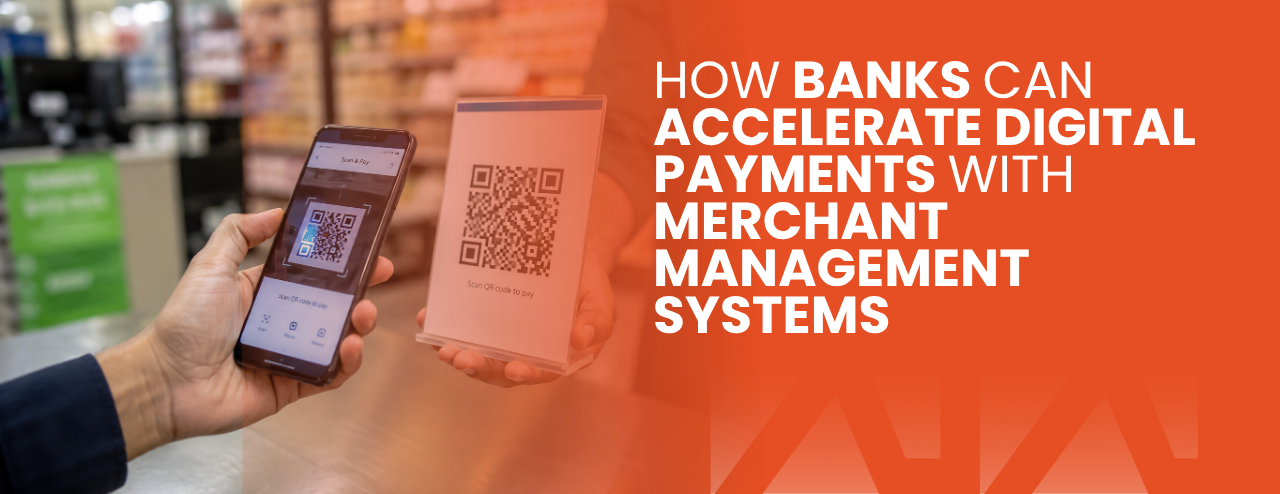
Digital payments are growing faster than most banks anticipated. QR codes are appearing at roadside stalls, shopping malls, and everything in between. Yet behind every seamless scan-and-pay moment is a layer of infrastructure that most consumers never see and that many banks are still struggling to get right.
That infrastructure is the Merchant Management System.
The Gap Between Issuing and Acquiring
Most banks are comfortable on the issuing side giving customers cards, accounts, and mobile apps to make payments. But acquiring is a different discipline entirely. It means enabling merchants to receive payments, managing their onboarding, ensuring compliance, generating QR codes, processing transactions in real time, and settling funds accurately.
Many banks have treated acquiring as secondary. That is changing rapidly, and the banks that close this gap earliest will capture merchant relationships that are genuinely difficult for competitors to take away later.
What Is a Merchant Management System?
A Merchant Management System is the operational platform that manages the full lifecycle of a bank’s merchant acquiring business. It connects the bank, the merchant, and the national payment scheme handling everything from the moment a merchant applies to join, all the way through to daily settlement.
At its core, an MMS is responsible for:
- Registering and verifying merchants digitally
- Generating and managing QR codes at branch and terminal level
- Routing and processing real-time payments
- Managing fees, limits, and merchant categories
- Reconciling transactions and producing settlement reports
- Providing merchants with a self-service interface to manage their own accounts
Without this system, all of these functions fall back on manual processes, disconnected tools, and operational teams that spend more time firefighting than growing the business.
Why This Matters More Than Ever
National QR schemes are raising the bar. Across Asia, Africa, the Middle East, and Latin America, central banks and payment authorities are rolling out interoperable QR payment standards. Participating banks must meet specific technical, security, and certification requirements. An MMS is what enables a bank to meet those requirements and stay compliant as the scheme evolves.
Consumer expectations have permanently shifted. Customers now expect to scan and pay everywhere. Merchants expect their bank to provide that capability as a standard service. Banks that cannot deliver it are not seen as behind the times they are seen as operationally inadequate.
MDR revenue is growing. As QR transaction volumes grow, so does the merchant discount rate revenue that comes with them. Banks that build strong merchant portfolios early are accumulating a compounding revenue stream that rewards scale.
The Operational Complexity Banks Underestimate
One of the most common mistakes banks make is underestimating what merchant acquiring actually involves at an operational level.
Onboarding a single merchant sounds simple. But at scale, you are dealing with thousands of merchants across multiple business categories, each with different risk profiles, fee structures, and compliance requirements. Duplicate registrations must be detected. KYB checks must be documented. QR codes must be assigned, tracked, and deactivated when merchants leave.
Then there is the payment flow itself. In an interoperable QR scheme, your bank functions in two directions simultaneously as the institution whose customer is making a payment at someone else’s merchant, and as the institution whose merchant is receiving payments from customers of other banks. Both flows require different processing logic, and both must work flawlessly.
Settlement adds another layer. Transactions from dozens of acquiring banks must be matched, reconciled, and settled through the central payment infrastructure daily, accurately, and with full auditability.
None of this can be managed with spreadsheets and manual processes once you reach any meaningful scale.
Key Capabilities a Mature MMS Should Deliver
Not all MMS platforms are equal. Banks evaluating options should look for the following as non-negotiable capabilities:
End-to-end merchant lifecycle management: from digital application and KYB through to offboarding, with full audit trail at every step.
Dual-flow payment processing: the ability to handle both outgoing payments (your customer paying another bank’s merchant) and incoming payments (another bank’s customer paying your merchant) within the same platform.
Dynamic and static QR support: static QRs for standard counter payments, dynamic QRs generated per transaction for itemized or variable-amount sales.
Automated reconciliation: daily matching of transaction records against settlement files, with exception handling and dispute support built in.
Configurable fee management: MDR rates, transaction limits, and merchant category configurations that operations teams can manage without developer involvement.
Merchant self-service: a portal where merchants can view transactions, manage branches, download reports, and raise support requests independently.
Scheme certification readiness: the platform should be designed to meet the technical and security requirements of national QR certification bodies, not require significant rework to pass them.
Conclusion
A Merchant Management System is not a nice-to-have for banks that want to participate meaningfully in digital payments. It is the foundational infrastructure that makes merchant acquiring operationally viable at any real scale.
Banks that invest in getting this right whether through building, buying, or partnering will be better positioned to grow merchant portfolios, generate fee revenue, meet regulatory expectations, and serve customers in the way the market now demands.
The complexity of merchant acquiring is real. But so is the opportunity for banks that build the right infrastructure to manage it.
Ready to launch your own Merchant Management System? Connect with Lambda Payments we deliver white-label MMS solutions and handle the full national QR certification process as per your country’s payment scheme requirements, so you go live faster with zero certification uncertainty.